



Lee Man-hee: An Auteur Beyond Time - 50th Memorial Retrospective
Date : 2025.09.04.Thu ~ 09.13.Sat
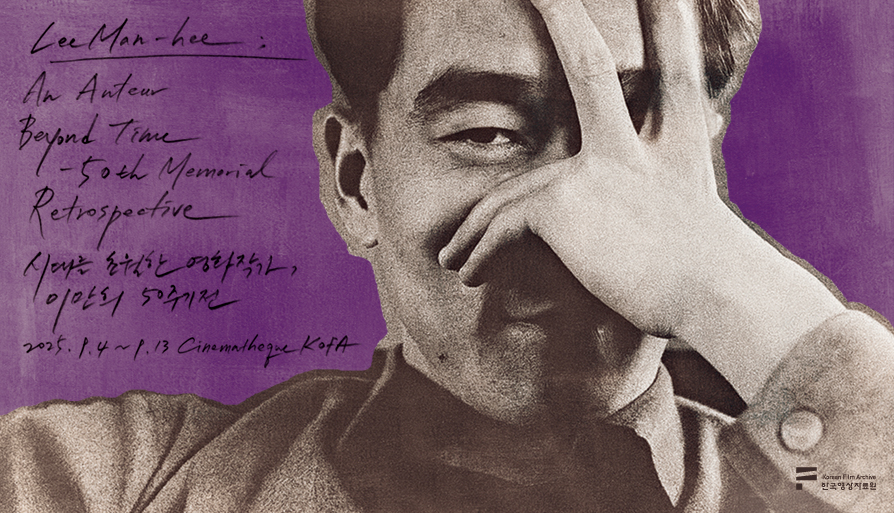
Fifty years have passed since director Lee Man-hee left this world at the age of 43. Although more time has elapsed since his death than the years he spent living among us, we still remember his films and return to them again and again. What, then, is the reason his works continue to be summoned across half a century?
‘Lee Man-hee: An Auteur Beyond Time – 50th Memorial Retrospective’ begins precisely with that question.
“You stood with the soldiers who crawled silently under falling shells, with the lovers who walked the human path despite knowing despair, and with the youth who had to grow strong because they hated violence.”
These words, inscribed by novelist Kim Seung-ok on Lee Man-hee’s tombstone, reveal much about the director and his cinema. In 1950, at the outbreak of the Korean War, the eighteen-year-old Lee enlisted and spent five years as a signalman on the front lines. Beginning with his breakthrough film <돌아오지 않는 해병>(1963), which cemented his presence in Korean cinema, he went on to direct a total of eleven war films, including <YMS 504의 수병>(1963), <7인의 여포로(돌아온 여군)>(1965), <군번없는 용사>(1966), <냉과 열>(1967), <얼룩무늬의 사나이>(1967), <싸리골의 신화>(1967), <여로>(1968), <창공에 산다>(1968), <04:00 -1950->(1972), and <들국화는 피었는데>(1974).
That eleven out of his fifty-one films—more than one-fifth of his oeuvre—are war films suggests how profoundly the war shaped him. Even in works where war is not the direct backdrop, such as <귀로>(1967), depicting a woman who continues life with her disabled veteran husband, or <휴일>(1968), whose protagonist speaks of feeling as though he is “heading into battle,” war appears as an essential motif throughout his filmography. After suffering persecution in 1964 when <7인의 여포로> was accused of violating the Anti-Communism Law, Lee continued to craft works centered not on anti-Communist propaganda but on anti-war sentiment, striving to articulate the messages he had witnessed on the battlefield in his own cinematic vocabulary.
As the epitaph continues, Lee Man-hee’s cinema is filled with “lovers who walk the human path despite knowing despair” and “young people who had to become strong because they hated violence.” Both figures ultimately choose love over nihilism. If his characters wander endlessly—through the bustling streets of the city or along rugged mountain paths, as in <귀로>, <태양닮은 소녀>(1974), <휴일>, and <원점>(1967)—it is because of love: a love lost, a love newly appearing, or one that must now be left behind.
The drifters of <삼포가는 길>(1975) and <물레방아>(1966) find the courage to live through love, while others lose their lives because of it. In <검은 머리>(1964), which precedes <흑룡강>(1965), <잊을 수 없는 연인>(1966), and <만추>(1966) in its depiction of impossible love, the protagonist realizes that “a loveless life is worth less than death.” For Lee, to whom the lover often served as a persona, film–life–love were all one and the same. When conceiving a film, he would look into a mirror to consider the expressions and rhythms of his characters; he himself was the soldier crawling under shells, the lover walking the human path despite despair, and the youth forced to become strong in the face of violence.
Film historian Lee Young-il once recalled that Lee Man-hee “stood apart because he possessed a clearer authorial consciousness than those who excelled merely in the technical functions of directing.” Many filmmakers of the 1960s and 1970s—his contemporaries who breathed the same historical air—did not hesitate to call him one of Korea’s true film auteurs. To them, even before history bestowed its retrospective glow, Lee was “one of the few directors in Korea, past or present, who demonstrably possessed a unique auteurist world.”
As seen in the ending of <삼포가는 길>, where even the sequences added to pass censorship bear his unmistakable imprint, Lee was a filmmaker who broke through the dual pressures of industry and censorship not by submitting to constraint, but by forging an autonomous cinematic language.
‘Lee Man-hee: An Auteur Beyond Time – 50th Memorial Retrospective’ seeks not to enshrine his works merely as canonized classics whose x-evaluations have long been settled. The retrospective begins with a conversation between cinematographer Lee Seok-gi and senior researcher Cho Jun-hyung on <휴일>. Following the screening of <돌아오지 않는 해병>, actress Lee Hye-young and Hwang Min Jin, programmer at Cinematheque KOFA, will hold a discussion and reading.
Additional programs include director Oh Seung-uk’s talk, “<귀로>: Emotions Along the Road”; a conversation between director Kim Jee-woon and Jinnie Myung-hyun (CEO of Movie Movement) titled “<쇠사슬을 끊어라>: The Landscape of the Korean Western”; a discussion after the screening of <태양닮은 소녀> featuring film historian Geum Dong-hyun and music critic Na Won-young, “Lee Man-hee and the Youth: The Penultimate World”; a dialogue between critics Shin Eun-sil and Kim Ye-solbi on “<물레방아>: Strangeness and Misalignment”; and a lecture by film historian Park Yu-hee, “The Ethics of Parricide and the Discipline of Verisimilitude: <군번없는 용사>.”
Through this retrospective, we hope to fill the long-overlooked gaps left behind in the fifty years since Lee Man-hee’s passing, tracing anew the many traces this singular film auteur left—quietly yet indelibly—across Korean cinema.
Films
Lecture / Performance / Event
-
kofa@koreafilm.or.kr
© Korean Film Archive. All Rights Reserved