



Vietnam, The Body in Transition: Kinesis, Meditative, Record
Date : 2026.02.27.Fri ~ 03.11.Wed
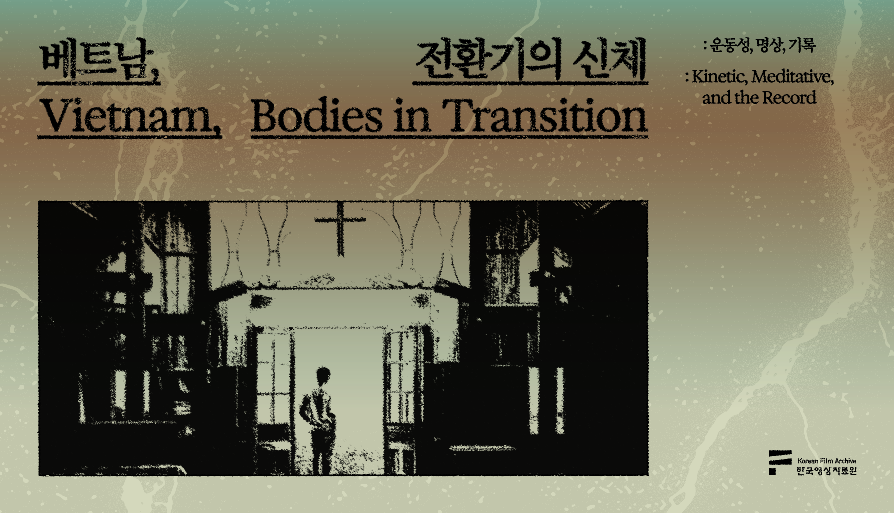
This screening program ten contemporary Vietnamese films that have garnered significant acclaim on the international film festival circuit. Through these works, we aim to trace the shifting sensibilities of Vietnamese cinema over the past decade. The central axis connecting these films is the “body.” Here, the body is not merely a visual subject; it is a site of translation where the pressures of state and social censorship (including self-censorship), rapid urbanization, and shifting labor conditions and traditions are etched into a character’s gait, breath, hesitant gestures, and enduring postures. In this context, cinema favors affect over explanation, inviting the audience to feel before they understand.
The program is organized into three thematic coordinates: Kinesis, Meditation, and Record. However, these categories are not rigid compartments but rather navigation points for reading sensibilities that overlap and slide into one another. While some films naturally bridge multiple sections, each has been placed according to its most dominant rhythm to provide a path for the audience to follow.
Since the 1980s, Vietnamese cinema has gradually expanded its presence through sporadic international recognition. A defining moment in this trajectory was Tran Anh Hùng’s The Scent of Green Papaya (1993) winning the Caméra d'Or at Cannes. Following this, international discourse often categorized Vietnamese cinema under the labels of “lyrical imagery” and “exquisite sensibilities.” Naturally, these frameworks alone cannot encapsulate the breadth of Vietnamese film. The works of DANG Nhat Minh, which addressed the lives of the people and historical tragedies, as well as the diverse attempts by Vietnamese diaspora filmmakers, continued to push boundaries. A key predecessor to the current movement we are highlighting is Phan Dang Di’s Bi, Don’t Be Afraid! (2010).
While referencing this lyrical legacy, the more recent works in this exhibition recalibrate the camera’s distance from its subjects. By drawing closer to the characters, the camera captures their most minute changes. Long, unbroken shots hold the gaze, documenting the time it takes for a character to endure and move again. While they share a common reality, each film pushes its formal boundaries differently—some accelerate speed, some distend time, and others interweave archival materials.
Kinesis: Focuses on bodies in motion—those being chased and the energy generated through physical friction in environments like city streets or mountain villages. In Ròm, fragmented blocking and an urgent rhythm use the lean body of a boy racing through the concrete jungle to embody the struggle for survival. In Children of the Mist, the camera refuses to maintain a safe distance amidst the rugged terrain and the volatile "bride kidnapping" rituals. The shaky handheld breathing and tight tracking create a tension between ethics and reality, causing the audience to lose their sense of safety. In Flapping in the Middle of Nowhere, the camera captures bodies adrift in the humid night air of an urban landscape with no apparent exit. Here, kinesis signifies not just speed, but the act of adjusting one's posture while being pushed, encompassing both choice and hesitation.
Meditative: Deals with moments where the body sinks into time that stagnates rather than flows. Inside the Yellow Cocoon Shell eschews traditional plot or causality, using long takes to pull the body through mist, forests, and vast landscapes into a state of contemplation, creating an experience where boundaries blur. Cu Li Never Cries juxtaposes the face of an elderly woman harboring memories of loss with the life of her niece preparing for marriage, showing how past places take hold of the present. Viet and Nam reveals suppressed desires and the shadows of state violence through the intertwined bodies in the darkness of a coal mine and the imagery of death (the grave). Taste uses slow duration to present the body as a virtual still life, pushing the nuances of posture and the texture of pain to their limits. In this section, meditation is not peaceful reflection, but a way of placing the body within high-viscosity time.
Record: Explores moments when archives, places, and x-x-x-x-x-x-x-x-x-x-x-x-x-x-objects transcend simple information to be revived as contemporary sensations. The Fifth Cinema traverses archives and personal memories to reveal that history never settles into a single conclusion. By intentionally misaligning the source of the image, the narrative, and the text, the film forces a realization that recording is an act of editing and rearrangement rather than mere organization. Hair, Paper, Water... connects tactile x-x-x-x-x-x-x-x-x-x-x-x-x-x-objects with historical memory, attempting to restore records as sensation rather than mere vision. Memoryland is a film where the land itself, harboring memory, bears witness to the rapidly changing landscape of Vietnamese society. In this section, recording is not about storing or preserving the past, but redefining and reflecting upon it through the sensibilities of the present.
The ultimate direction of this shift remains uncertain. However, capturing the minute movements of artists and forms just as they begin to change direction is a profound joy for any cinephile. We hope this exhibition serves as an opportunity for you to discover new auteurs.
Films

kofa@koreafilm.or.kr
© Korean Film Archive. All Rights Reserved