



MELVILLE x MANN x REFN
Date : 2026.03.12.Thu ~ 04.07.Tue Venue : Cinematheque 1
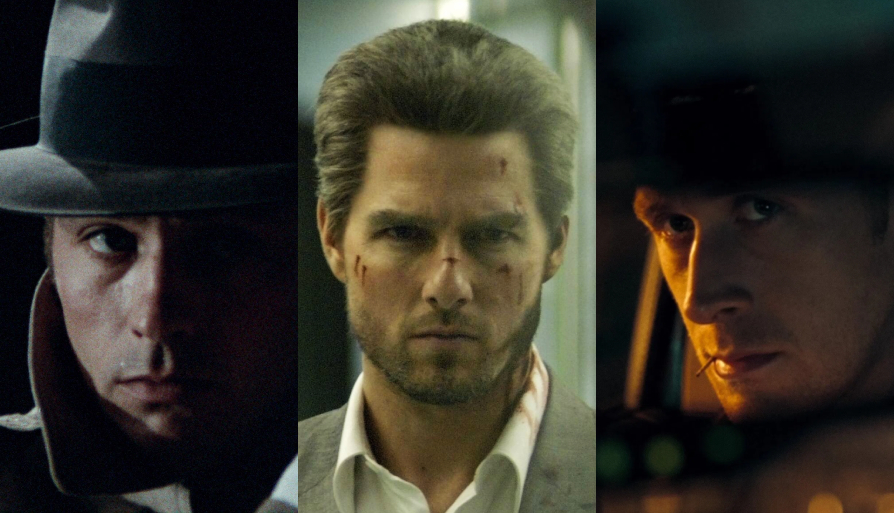
In a dilapidated apartment, a lone wolf assassin slips on a trench coat and fedora before a mirror, carefully running his fingers along the brim before heading out to fulfil his contract. In a pristine bank vault, a jewel thief surveys the room as he approaches the towering safe door, preparing for the work ahead. On the streets of Los Angeles, a getaway driver fastens his wristwatch to the steering wheel, synchronizing himself with the break-in across the way. It is the calm before the storm for these individuals, defined by ritual, precision, and solitude. These figures of shadow form the core of the three filmmakers whose work this program sets in dialogue.
MELVILLE x MANN x REFN brings together the crime noirs of Jean Pierre Melville, Michael Mann, and Nicolas Winding Refn, three filmmakers separated by generation and geography, yet united by a fascination with outsiders and the codes they live by.
"The world of criminals is the last bastion where the fires of good and evil confront each other. It is the refuge of modern tragedy." - Jean-Pierre Melville
Jean Pierre Melville (1917–1973) is a pioneering figure of post war French cinema and a spiritual godfather of the French New Wave. He adopted his surname from author Herman Melville while serving in the French Resistance, an early indication of his deep affinity for American culture. Inspired by the Hollywood film noirs of the 1930s, he crafted existential tales of professionals on both sides of the law that were at once austere and mythic, culminating in masterpieces such as Le Deuxieme Souffle (Second Breath), L'Armee des Ombres (Army of Shadows), Le Samourai (The Samurai), and Le Cercle Rouge (The Red Circle).
"There's people who live life authentically and there's people who live a life of fabrication. And it begins with the question of how you're gonna do your time." - Michael Mann
Michael Mann (b. 1943) began his career writing television police procedurals before emerging in the early 1980s as one of the defining voices of American crime cinema. Films such as Thief, Heat, Collateral, and Miami Vice reveal his meticulous research into the lives of law enforcement and career criminals. Mann's commitment to authenticity transforms genre filmmaking into a study of obsessive professionalism and solitary masculinity.
"What do you think creativity is? Nothing but self-indulgence. And the more self-indulgent it is, the more interesting it becomes." - Nicolas Winding Refn
Nicolas Winding Refn (b. 1970), son of a film editor father and cinematographer mother, found critical acclaim with his feature debut Pusher, launching a trilogy that explored the brutal underbelly of the Copenhagen criminal world. His international breakthrough, Drive, earned him the Best Director prize at Cannes and cemented his reputation for sculpting neon-drenched psychological dreamscapes.
Though distinct in temperament and style, these filmmakers each left an indelible mark on crime noir through their explorations of the interior and exterior lives of outsiders. Operating at the intersection of commercial and arthouse cinema, they mobilize the tools at their disposal to craft works of striking audiovisual spectacle, collaborating with major stars of their era to harness and reshape their screen personas. Across their films runs a sustained meditation on mortality and fate, refracted through melancholic masculinity. Their uncompromising visions have often polarized critics and audiences alike, yet their films retain an intoxicating power that continues to inspire devoted cult followings.
Much of the pleasure in their work arises from their engagement with and transformation of the iconography of genre cinema. This retrospective therefore focuses exclusively on their crime films, allowing us to trace how each director refines and reworks genre conventions across their works. Through repetition of genre tropes and personal obsessions, they cultivate a signature style so pronounced that it begins to overwhelm the film itself. In their later works, narrative and character development grow increasingly sparse until we are left with mere sketches and archetypes. This brings to the forefront a feeling of void that has divided critics and audiences alike. Yet it is this void that is perhaps their most fascinating achievement, a pure distillation of the loneliness and melancholy that has always haunted their characters. As the style of the film consumes and becomes the substance, we are invited to become one with the figures of shadow.
At the filmmakers' finest moments, performance, cinematography, mise en scène, and music fuse into something ineffable. Jef Costello stepping onto the rain-slicked streets of Paris in his trench coat and fedora in Le Samourai. Frank lighting a cigarette after a successful score in Thief. The Driver gliding through Los Angeles to the pulse of synths in Drive. In such moments, we witness the birth of mythology, born of the myths that came before and shaping those still to come. For a fleeting instant, we sense that we are in the presence of greatness.
Films

kofa@koreafilm.or.kr
© Korean Film Archive. All Rights Reserved