



Trip Cinema: Substance, Interface, Assembly
Date : 2026.04.08.Wed ~ 04.30.Thu
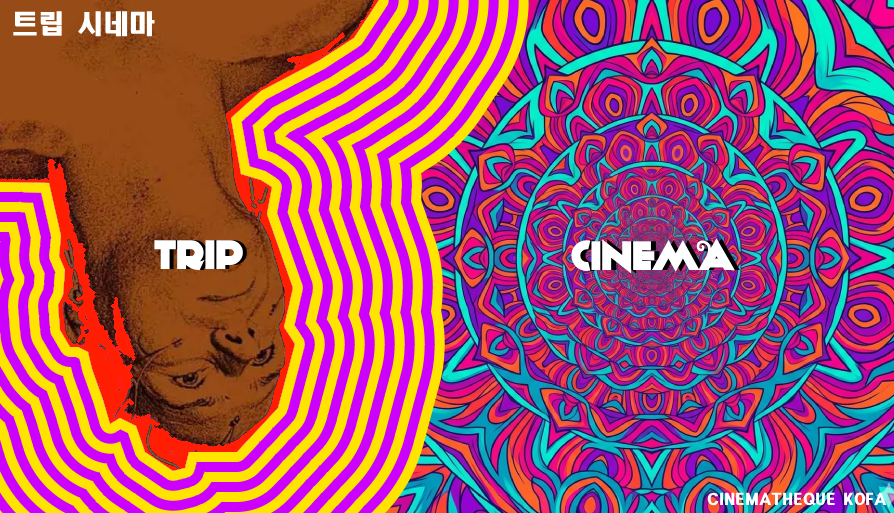
When watching a movie, we occasionally find ourselves haunted by existential questions: "Where am I?", "Who am I?", and "What is that?" This exhibition is a journey of that very nature. While the films that evoke these sensations vary in their textures—some through grueling runtimes and others through images that defy logic—this program focuses on the latter: a journey through the inversion of perception. The new territories we are about to enter will likely thrust us into their depths with a certain ferocity.
From its inception, cinema has been a medium that transports audiences to "elsewheres." At times, these worlds were born of a colonial gaze and a history of exploitation, yet the "unfamiliar" has always remained an x-x-x-x-x-object of profound fascination. While genres like Sci-Fi and Fantasy have visualized unknown spaces and concepts beyond our reality, other films have allowed us to glimpse the lives and cultures of others, or led us into sensory realms that are otherwise inaccessible—realms of war, violence, hallucinations, and dread. 〈Trip Cinema: Substance, Interface, Assembly〉 showcases works that explore these territories: places most have never visited, places that defy verbal description even if visited, or places so perilous that one must flee them in haste.
The journey begins in the 1960s. Amidst the surge of counterculture, drugs were seen as the most direct gateway to unfamiliar sensations. Although the grand ambition of discovering a new consciousness or a "new human" through these substances largely failed—thwarted by the pressures of the state and capital—the realms of ecstasy and hallucination experienced during this era frequently led to the collapse of the self and the onset of delirium. In some sense, these experiences resonate with a poetics of catastrophe. This exhibition takes that very point as its departure.
The first section, Substance, features films where external elements penetrate the interior to create a perceptual derangement, while offering a critical reflection on their era. Roger Corman’s The Trip (1967) stands as a quintessential starting point, capturing the vivid energy generated when psychedelic sensibilities meet cinematic form. This is followed by Easy Rider (1969), featuring Peter Fonda and Dennis Hopper (with a screenplay by Jack Nicholson), who first collaborated on The Trip. As a cornerstone of the "New American Cinema," it encapsulates the disillusionment and anxiety of a counterculture generation amidst the Vietnam War and political assassinations through images of the open road. This section also includes Alejandro Jodorowsky’s The Holy Mountain (1973), a pinnacle of sensory excess; Terry Gilliam’s Fear and Loathing in Las Vegas (1998), which satirizes America through the madness of Las Vegas; Adrian Lyne’s Jacob’s Ladder (1990), capturing nightmares born of war and chemicals; Oliver Laxe’s Syrat (2024); and finally, Daemachoui haedok(1976), a government-produced cultural film intended to warn against the dangers of marijuana, yet one whose hallucinatory form exists in a strange friction with its own didactic content.
The second section, Interface, examines moments where humans merge with media, becoming synchronized with its signals and operations, while questioning the human condition and ethics. These works largely belong to the "Body Horror" genre. Ken Russell’s Altered States (1980) serves as the bridge here; it depicts a young William Hurt injecting hallucinogens and entering a sensory deprivation tank to explore human origins—a classic Russell-esque take on "Jekyll and Hyde." David Cronenberg’s Videodrome (1983) and eXistenZ (1999) treat media not as a mere tool or extension of the body, but as an invasive device that transforms the self and threatens its very nature. Kathryn Bigelow’s Strange Days (1995) delves into the ethics of connection in a world where memories and experiences are traded as commodities. Shinya Tsukamoto’s Tetsuo: The Iron Man (1989) is the quintessential manifestation of industrial grotesque, an essential text in the discourse of human-machine fusion. Lastly, Godfrey Reggio’s Koyaanisqatsi (1982) is a hypnotic work that utilized techniques once considered alien to invite a mechanical form of immersion and participation.
The final section, Assembly, is a space where the "outside," "reality," and "truth" become blurred. While the previous sections focused on the body and its internal changes, the agency here shifts to the screen itself. Cinema as a medium begins to manufacture and rearrange sensations directly upon its surface. In this stage, the plot or what the characters undergo is secondary. Form takes precedence over narrative, and unlike the "Interface" stage, the lines pointing toward an external reality are erased. Instead, the worlds into which the audience is summoned are hauntingly seductive in their "flatness." Stanley Kubrick’s 2001: A Space Odyssey (1968), though fitting for the "Substance" category, is presented here for its ambition to seize the audience through light and abstract patterns, reconfiguring the very framework of perception. We also feature Satoshi Kon’s Paprika (2006), where collective unconsciousness and technology merge to dissolve reality; The Wachowskis’ Speed Racer (2008), which creates a flat, hyper-synthetic aesthetic; Gaspar Noé’s Enter the Void (2009), floating through Tokyo from a post-mortem perspective; Paul Verhoeven’s Showgirls (1995), a masterpiece of camp aesthetic built as an artificial organism; Harmony Korine’s Spring Breakers (2012), which uses neon palettes, the music of Skrillex, and loops of image and sound to create a surreal beauty out of the volatility of youth; and finally, Panos Cosmatos’s Mandy (2018), a blood-soaked revenge epic that constructs an eerie, otherworldly environment.
Reflect on the daily lives of contemporary audiences—or indeed, my own. Returning home, we flip through short-form videos, surrender ourselves to auto-play and recommendation algorithms, and cross-reference the veracity of provocative videos on X with Grok. Our trust in what we perceive and encounter is already wavering, constantly being recalibrated. In this light, 〈Trip Cinema〉 may have begun with films that represent hallucination, but it ultimately allows us to experience the process of being shaken, connected to the other, and newly rearranged. The strange and grotesque sensations encountered here will, conversely, force us to reflect on the chaotic environment in which we currently stand.
Films

kofa@koreafilm.or.kr
© Korean Film Archive. All Rights Reserved