Wangsimni (Im Kwon-taek, 1959)
Genealogy (Im Kwon-taek, 1959)
Jagko (Im Kwon-taek, 1959)
Mandala (Im Kwon-taek, 1960)
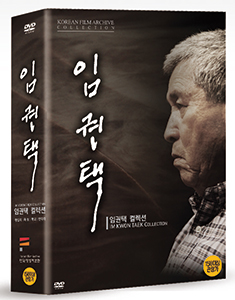
This contains a total of four films produced between the mid-/late 1970s and the early 1980s: <Wangsimni> (1976), <Genealogy (Jogbo)> (1978), <Jagko> (1980), and <Mandala> (1981). These films correspond to the works produced during the time Director Im Kwon-taek went beyond being a professional director and made efforts to depict the stories he wanted to tell in a style unique to him. Although <Wangsimni> relied on the commercial frame of genres, melodrama, and action, it told the story of hometowns reflecting the author’s consciousness. <Genealogy> is a work for which the “Im Kwon-taek style” was heavily employed instead of Western movie styles under the topic of nation. <Jagko> was made as an anticommunism film for selection as an “excellent movie” but projected the director’s personal affairs. Finally, <Mandala>, which advanced into the competition sector in the 32nd Berlin International Film Festival, has been recorded as the first work that made Im Kwon-taek an international sensation.
A characteristic of the “Im Kwon-taek Collection” is that Director Im Kwon-taek participated firsthand in the voice-over of all the films together with his junior movie crew. For <Wangsimni>, Critic Kim Yeong-jin participated in recording; for <Genealogy> and <Mandala>, Critic Chung Sung-ill participated in recording together with Director Im Kwon-taek to analyze the works meticulously. In particular, the DVD of <Jagko> contains two versions -- one recorded by Critic Huh Mun-yung and Director Im Kwon-taek and the other recorded by Professor Kim Hong-jun and Author Song Gil-han -- to add to the density of analysis. This DVD is also accompanied by a pamphlet 72 pages long. This pamphlet contains not only the biography of Director Im Kwon-taek and a filmography of 101 films but also Movie Critic Chung Sung-ill’s theory of directors (“4 is not 2. Therefore, you cannot divide 101 by 2. ...And Im Kwon-taek’s parentheses of 1976 to 1981”) in Korean/English. The main DVD contains a preview of <Wangsimni> (4 minutes), a video comparing before and after the restoration (3 minutes) of <Mandala>, and a gallery of individual works.