



Yu Hyun-mok Centennial: Era, Genre, Practice
Date : 2025.06.26.Thu ~ 07.05.Sat
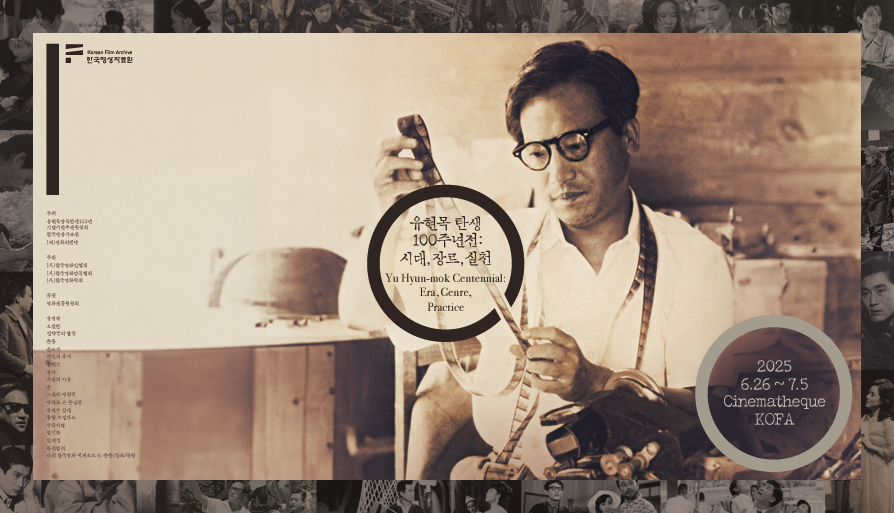
The Korean Film Archive, in collaboration with the Yu Hyun-mok Centennial Organizing Committee and the Busan Cinema Center, will present “Yu Hyun-mok Centennial: Time, Genre, Practice” from June 26 to July 5, 2025.
This special retrospective is dedicated to exploring the layered cinematic world of Yu Hyun-mok, a pioneer of Korean realist cinema and a filmmaker deeply committed to social practice. Alongside his most acclaimed works, the program includes lesser-known melodramas, comedies, children's films, and experimental pieces. It also sheds light on his contributions as a producer and educator. Through this comprehensive approach, the retrospective revisits the boundaries of genre and form, the tension between ethics and aesthetics, and the ways in which one filmmaker read—and responded to—his time through cinema.
Born in 1925 in Sariwon, Hwanghae Province (now in North Korea), Yu Hyun-mok remained an essential figure in Korean cinema until his passing in 2009. Since his directorial debut with Crossroads (1956), he directed over 40 films across five decades. Many of these works continue to raise resonant questions even today. Among them, Obaltan (The Aimless Bullet, 1961)—banned by the military government shortly after its release—is now considered one of the greatest films in Korean cinema history. Heavily influenced by Italian Neorealism and German Expressionism, the film visualizes the contradictions and despair of postwar Korean society with striking formal rigor.
Yu once said that he sought to “think cinematically.” Having nurtured a deep interest in the visual arts since childhood, he developed a cinematic language grounded not in dialogue, but in mise-en-scène, framing, lighting, and camera movement. This approach can be seen consistently throughout his oeuvre—from his earliest surviving film, Forever With You (1958), to Obaltan, The Martyr (1965), and particularly in formally bold works like The Hand (1975) and Spring Dreams (1965).
Yet to remember Yu solely as a “serious” filmmaker would be incomplete. In private, he reportedly hoped to be remembered as “a funny person.” Indeed, School Excursion (1969), starring non-professional child actors and comedian Koo Bong-seo, overflows with energy and humor, while Three Generations of a Henpecked Husband (1969) playfully satirizes the secret alliances of men living under strong-willed women.
Beyond his work as a director, Yu also played an important role in shaping Korean film culture. He initiated experimental film projects through groups such as Cinepoem and the Korean Small-Gauge Film Club, founded Yu Production to produce cultural and animated films, launched the East-West Film Study Society to promote the cinematheque movement, and taught generations of students at university. His contributions as a producer and educator were as intentional and committed as his cinematic work. As critic Byun In-shik once declared, “Yu Hyun-mok is cinema”—a statement that reads not as praise, but as a truth etched into the history of Korean film.
This retrospective presents 18 works: 16 narrative features directed by Yu, one animated film he produced, and a film essay reinterpreting his cinematic world. The highlight of the program is Im Kkeok-jeong (1961), made the same year as Obaltan and recently restored in 4K after being discovered at the Library of Congress in 2022. Based on the novel by Hong Myung-hee, the film is a rare historical epic in Yu’s filmography and will be screened in Korea for the first time in its restored version. Other featured works include the newly digitized 4K restoration of The Martyr (1965), 35mm screenings of Forever With You, Boon-rae’s Story (1971), and his final feature Sea Anemone (1996).
Eight accompanying programs will offer deeper insight into Yu’s cinema. The retrospective opens with a talk by Ji-young Lee (Film Archive Collection Specialist) and historian Ji-hoon Seok on the rediscovery of Im Kkeok-jeong. Cine-talks will follow screenings of The Hand, Spring Dreams, and My Korean Cinema Episode 6, featuring Kim Hong-joon (Director of the Korean Film Archive) and researcher Joon-hyung Cho. In addition, directors Kim Sung-soo and Lee Gong-hee, as well as critics Maeng Soo-jin, Jeon Chan-il, and Jung Jae-hyung, will participate in audience discussions and introductions. Several of these events will take place in the form of informal “lounge talks” in the B1 lobby after screenings, offering a space for open dialogue and shared reflection.
Through this retrospective, we hope to revisit the name Yu Hyun-mok not as a figure of the past, but as a living question—one that asks how Korean cinema today might once again confront its time and society.
Films

kofa@koreafilm.or.kr
© Korean Film Archive. All Rights Reserved